 |
Web and mobile tech has become indispensable to business
Image
credit: Gerd Altmann (CC0 1.0)
|
A Changing Marketplace
While traditional print and broadcast media remain an integral part of modern advertising strategy, digital channels have become increasingly useful as social media and mobile applications have gained widespread acceptance by the public at large. Laurie (2010) comments that “Marketing and advertising is transforming itself from an industry reliant on mass market channels to one which must embrace the power of the consumer and (attempt to) engage in conversations” (para. 12). Companies are discovering that having a clear social media plan, developing engaging content, and optimizing their web presence to increase search engine traffic (as described in detail in the video below) are as important as advertising via billboards, television, and print periodicals.
Top Five Social Media Marketing Trends for 2015 (Engage Target Media)
New Opportunities for Communications Professionals
Organizations have long employed spokespeople, public relations experts, speakers, writers, and other communications professionals to present polished and carefully-crafted corporate statements. In the past decade, a host of new job titles have been added to the ranks of these marketing gurus, including community managers and social media managers. These nascent roles make use of new media to engage in content marketing, customer service, and "e-word of mouth" advertising.
With content marketing, organizations offer free information to consumers via blogs, websites, podcasts, and videos. Doing so provides a service to the audience, establishing the organization's credibility and potentially generating sales leads in the process.
Businesses have also found new opportunities for customer service and promotions via social media. Because disgruntled customers often turn to social media like Facebook and Twitter to vent their frustrations, some companies are monitoring the web for new posts containing targeted keywords so that they may engage in real-time customer interactions and alleviate customers' problems.
Levy and Gvili (2015) describe "e-word of mouth" advertising—marketing strategies designed to elicit word of mouth (WOM) communications about products and services “on a variety of interactive media platforms, including social media, e-mails, web forums, blogs, and digital-virtual worlds” as a popular technique for developing brand awareness. They also explore the strange new concept of “artificial e-WOM”—an electronic word-of-mouth message “that is originated by marketers who then try to disguise its genuine source” in order to improve its “perceived credibility” (p. 95). While some of these strategies are shunned by organizations not wishing to alienate potential customers or business partners, all are examples of ways in which digital technologies have changed the role of communications professionals in business.
 |
| Infographic credit: Mindflash |
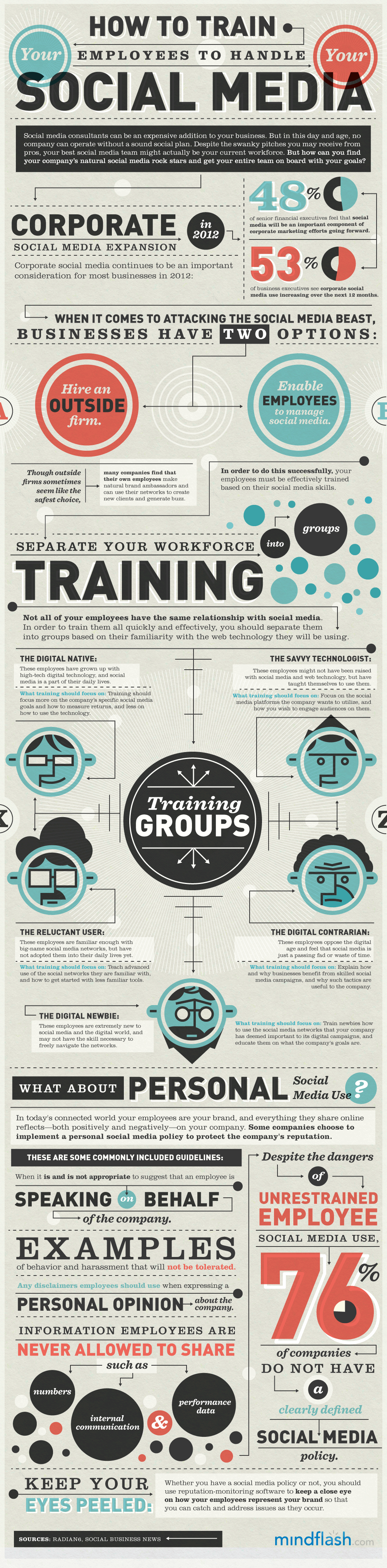
Although there are tremendous benefits to maintaining an online presence, both that corporate branding vehicle and employees' individual social media accounts present potential challenges. Thoughtful effort must be given to company policies designed to prevent public relations disasters and protect the privacy of both corporate secrets and consumer data. Because a company's employees might have their own social media accounts, many businesses feel it necessary to provide advice on responsible use of the platforms to all their workers, not just those in communications. Jennings, Blount, and Weatherly (2014) explain that, as "organizations use various forms of social media to improve the bottom line and maximize profits, individuals tend to share details of work and private life on social networks that broadcast information to thousands" (p. 97). In order to avoid possible consumer backlash against offensive or ill-advised tweets or other social media posts, companies want to educate their staffs to ensure that their brand image is not tarnished by workers not officially acting on behalf of the organization but nonetheless representing it by virtue of their association.
"It only takes one ill-worded or ill-timed post to create a company nightmare," write Jennings, Blount, and Weatherly (2014), "so the sheer number of employees using social media opens a floodgate of opportunities for disaster" (p. 99). Employees could also potentially reveal proprietary or confidential corporate information or leak time-sensitive promotional materials in advance. As such, many organizations find training "to inform employees of what they can and cannot do via social media" (p. 110) to be essential.
Recap
The development of new media technologies—including mobile applications, blogs, image and video sharing sites, social media, and other online platforms—has revolutionized business communications and necessitated the creation of new company roles specializing in digital media communications. It has also made it important for organizations to train all employees on proper use of social media to lessen the potential for unpleasant public relations gaffes. Despite the need for caution, new digital technologies have afforded organizations an unprecedented array of customer interaction and public promotion tools.
_______________
References
Handley, A., & Chapman, C.C. (2012). Content rules: How to create killer blogs, podcasts, videos, ebooks, webinars (and more) that engage customers and ignite your business. Hoboken, NJ: Wiley.
Jennings, S. E., Blount, J. R., & Weatherly, M. G. (2014). Social media—A virtual Pandora’s box: Prevalence, possible legal liabilities, and policies. Business Communication Quarterly, 77(1), 96-113. doi:10.1177/2329490613517132
Laurie, M. (2010, January 7). How social media has changed
us. Mashable.com. Retrieved from
http://mashable.com/2010/01/07/social-media-changed-us/
Levy, S., & Gvili, Y. (2015). How credible is e-word of
mouth across digital-marketing channels? Journal
of Advertising Research, 55(1), 95-109. doi:10.2501/JAR-55-1-095-109

No comments:
Post a Comment